


Receipt validation that reads Europe's messiest receipts
Thermal paper, e-receipts, self-checkout formats, two dozen languages: FIBRE® turns a photographed receipt into a validated payout decision in minutes, with fraud screening before any money moves.
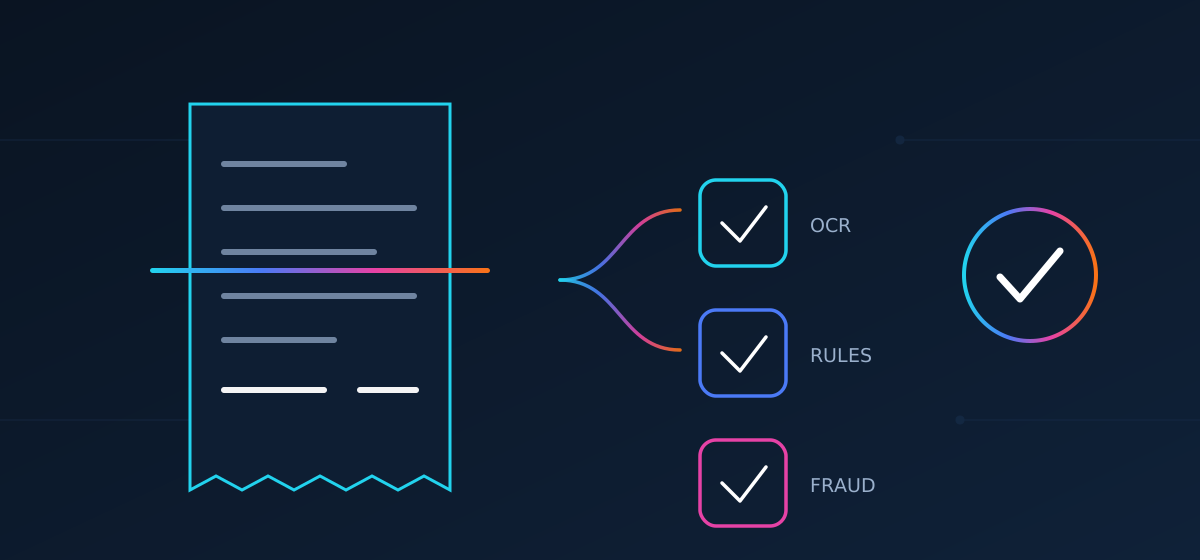
Capture
Consumers photograph or upload the receipt on your campaign site, in any market, in their language.
Validate
OCR reads retailer, date, products and totals; rules check product, quantity, window, retailer and market.
Pay out
Clean cases approve automatically, edge cases route to review, rewards and cashback are paid in minutes.
From photo to payout: what actually happens
Receipt arrives
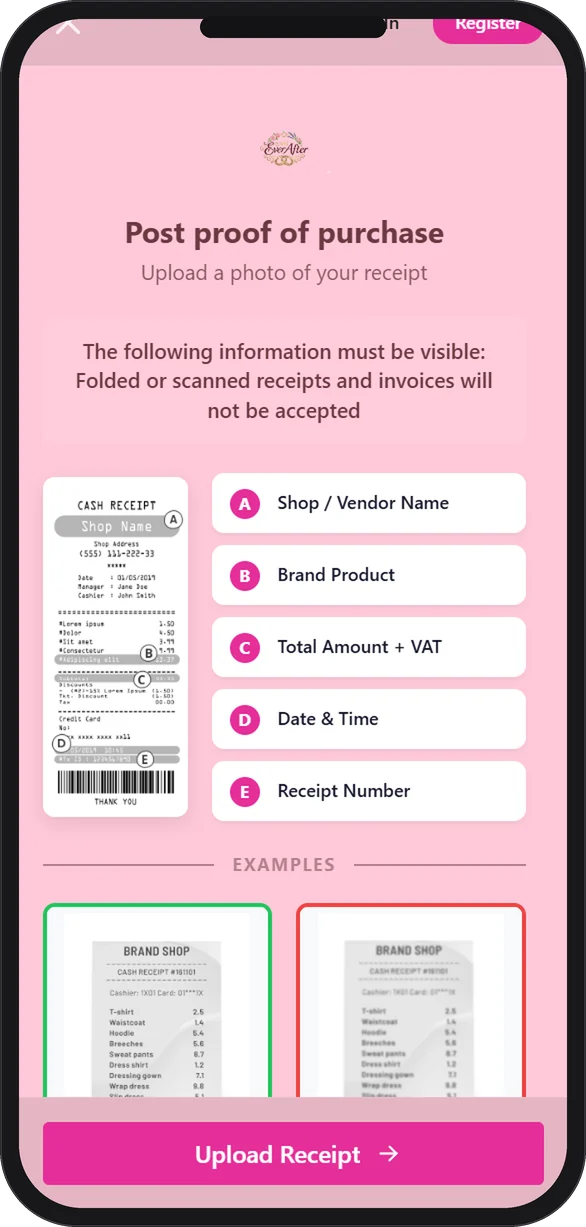
The consumer photographs or uploads the receipt, any format, any language.
Data extracted
The engine reads retailer, purchase date and time, line items with quantities, and totals.
Rules applied
Checked against the campaign rules: promoted product, qualifying quantity, purchase window, participating retailer.
FIBRE Shield™
Seven independent screening layers examine the entry before any decision is made.
Approve or review
Clean cases approve automatically; edge cases route to human review with full context.
Reward triggered
The reward or cashback is triggered automatically within minutes of approval; when it arrives depends on the local payment rail.
Live and CRM-ready
Every step lands in the live dashboard: validation rates, rejection reasons, payout status.
SKU-level verification
The promoted product, in the qualifying quantity, from a participating retailer, verified line by line. And FIBRE reads the whole basket, not just your product: every item on the receipt is extracted and categorised at SKU level.
FIBRE Shield™ fraud screening
Seven independent layers on every entry, from IP checks to document analysis. See the full stack below.
European receipt formats, across 41 markets
Retailer-agnostic processing across European chains and receipt layouts, with no per-retailer POS integration needed. That is the point of this route: it works in any chain without asking the retailer for anything. When a campaign instead needs the coupon to clear at the register, that is a different route, scoped with the chain — see sampling and retail activation.
Real-time reporting
Submissions, validation rates, rejection reasons and payout status, live per market and per retailer.
Every entry passes seven independent screening layers before a single reward is paid. Fraudulent, duplicate and invalid submissions are filtered out at no cost to you.
What each layer checks
1 · IP address checks. Flags entries from suspicious, masked or clustered addresses.
2 · Behavioural analysis. Spots unnatural patterns in speed, timing and repetition.
3 · Layout analysis. Checks the receipt structure against genuine retailer formats.
4 · Document analysis. Examines the file itself for signs of manipulation, including capture metadata (EXIF): when and how the photo was taken.
5 · Computer-based editing. Detects digital edits and re-saved or generated images.
6 · Textual analysis. Reads the text on the receipt and checks retailer wording, line items, totals and tax lines for consistency.
7 · Online fraud detection. Cross-references known fraud signals across entries, including image fingerprints that catch the same receipt template re-used across accounts.
Which receipt formats can FIBRE validate?
FIBRE processes printed thermal receipts, e-receipts and self-checkout formats from European retail chains, photographed under real-world conditions. Latin, Cyrillic and Greek receipt formats are covered as standard, which includes markets beyond Europe. For a further script such as Chinese, Japanese, Thai or Arabic, the validation layer is built for the campaign — name the market and we will scope it.
How fast are consumers paid?
Clean submissions are validated and paid within minutes; only edge cases go to human review.
Do we need retailer or POS integrations?
No. Receipt validation works from the consumer's photo, so campaigns run across any retailer without technical integration.
How is fraud prevented?
Several independent screening layers check every submission before payout, from image forensics to cross-campaign behaviour patterns.
What does the 95.5% figure actually mean?
It is the share of receipts decided automatically, not an accuracy score. In a benchmark of 5,000 receipts, 95.5% were resolved end to end without a person. The remaining 4.5% were flagged as uncertain by the trust score and decided by a trained reviewer before payout, so they are neither errors nor rejections. The split varies by market: the share going to human review is higher in countries with a large traditional retail sector, where receipt quality is more variable. Methodology and error rates, including false positives and negatives, are available under NDA.
Does FIBRE read only the promoted product, or the full basket?
The full basket. Every line item on the receipt is extracted and categorised, so brands see the promoted product in its real shopping context: categories, co-purchases and basket values. Insights are delivered aggregated, from consented participants, processed GDPR-first on EU infrastructure.
Related: Cashback & rebates · Sampling & retail activation · How receipt validation works
A receipt is not a yes-or-no question
A basic proof-of-purchase check answers whether your product appears on the receipt. FIBRE reads out every line — including your competitors’. Other providers read line by line too; what differs is whether it is included and what it costs. And which attributes get captured is yours to define.
- ✓Product description
- ✓SKU and EAN
- ✓Quantity per line
- ✓Unit price and line total
- ✓VAT rate per line
- ✓Retailer, location and date
- ✓Flavour and variety
- ✓Weight and fill quantity
- ✓Pack size and case unit
- ✓Variant and version
- ✓Promotional and value packs
- ✓Competitor products in the same basket
If your product differs by an attribute not listed here, that is the one we read. You define the target attributes, not us.
The platform →
Six real views from live operations: receipt check, rejected receipt, dashboard, customer file, builder, payouts.
Results →
What campaigns actually delivered, in numbers rather than adjectives.
Integrations & API →
Ready-made pages, embedded modules or API access from your own stack.
Security →
What IT and procurement check: data handling, access, encryption, incident process.
Trust Center →
Every major claim on this site with the evidence behind it.
Data & insights →
Zero-party data from sign-up, first-party purchase data from the receipt.
Loyalty programmes →
Points on verified purchases, tiers and redemption on the same platform.
Who it activates →
Four audiences, four interfaces: consumers, retail, field teams, sellers.
Case studies →
Mechanic, markets and what actually happened — campaign by campaign.
Planning a multi-market promotion?
Send your campaign brief with the markets, mechanic and timing. You'll get back a fixed, priced proposal, not a sales call. Or ask for the capabilities deck.